
Free
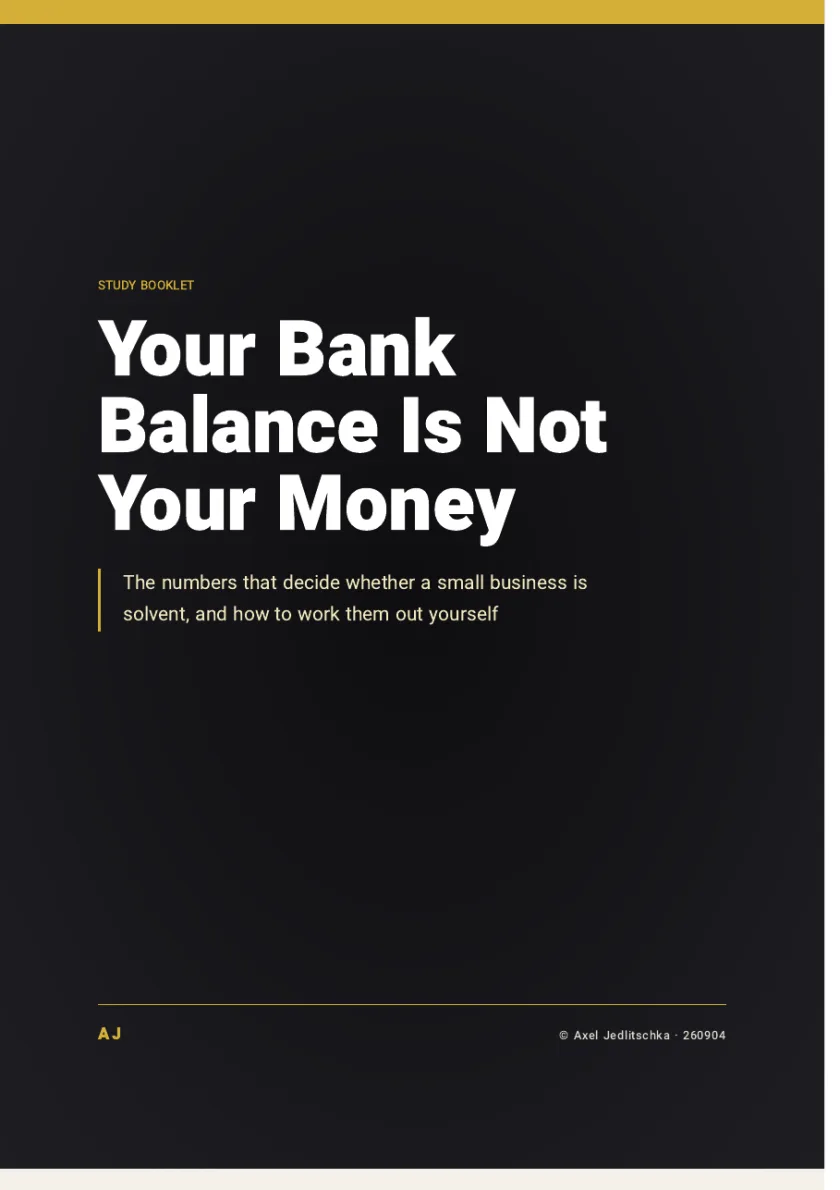
Your Bank Balance Is Not Your Money
- What you count
- Cash you could spend today, minus what you owe this month
- Debt
- Only the payment that falls due now
- When you know
- Every week, on a fixed day and hour
If you also look at the bank balance and ask yourself “Have I got money?”, you are not alone in that.
Where you are now
Could the number you are looking at include money that isn't yours? “An overdraft facility is not your money. It is permission to owe.” A post-dated cheque isn't cash. And the sales tax you charged sits in your account, looks like money, and is a liability.
And it costs you. You can have no money while the account looks healthy, and you can look at a long loan and say “I have an enormous debt”, when what decides is only what leaves this month.
And while decisions are made by the balance, you find out at the end of the quarter that you were short, not this coming Thursday. “A large balance with a falling trend is a countdown.”

Who's talking to you: Axel Jedlitschka
It all started with an income and expense table I wanted to build for myself in Excel. I built a few versions of it, and moved from there to Google Sheets.
What I learned along the way is that the way is not physical work, but thinking and managing resources, and that this can be mine. That is why I am against the glance at the bank balance: it is a real number, and it is very nearly meaningless.
Axel Jedlitschka
What to demand
Work out for yourself the number that replaces the bank balance.
Tell money you have earned from money you have received, and see why confusing the two is expensive.
Hold a single number that tells you, every week, whether you are above the line or below it.
Know the one question to ask before any expense, and how to spot the kind of spending that quietly kills small businesses.
Have a way to separate the money that looks like yours from the money that actually is.
There is a way
The bank balance is one number, and it doesn't subtract what you owe. What decides is two numbers: how much real cash you have, and how much you owe right now. You can work out both yourself, in ten minutes, with no accountant and no software.
“Finance is best understood as a commodity in terms of beans. So many beans issued to an activity and so many more beans back.” If you don't know how many beans come back, it isn't an expense. It's a hope.
The way, in one booklet
Your Bank Balance Is Not Your Money · a booklet by Axel Jedlitschka
Two numbers and a short weekly routine. That is enough to stop you guessing whether it was a good month.
The comparison
Free
The offer
49 pages, 10 chapters, an order of operations for when there is not enough, and five exercises
Price: FreeNo credit card, and no chapter is held back for payment
The booklet is free and you get it right away. You only get marketing messages if you tick the box, and you can unsubscribe at any time.
As soon as you leave your details, a thank-you page opens with a button to download the booklet.
By Axel Jedlitschka
What you get
There is no purchase and no payment here, so there is nothing to cancel. You can withdraw your consent to marketing messages at any time.
Questions?
You leave your details, and a thank-you page opens right away with a button to download the booklet as a PDF.
Yes. No credit card, and no chapter is held back for payment.
If you take one thing away from the booklet, take Chapter 5. That is where a single number is worked out that changes every other one. You can start there.
Your details are used to send you the booklet and to follow up on it. Marketing messages are sent only if you ticked the consent box, and you can unsubscribe at any time. You can also ask to see, correct or delete your details.
The booklet is complete, and no chapter in it is held back for payment. Every quote in it is anchored to a line in the source: 81 anchors, checked in the original Hebrew edition.
You don't need one. You work these numbers out yourself, in ten minutes, with no accountant and no software. The booklet doesn't teach bookkeeping. It teaches what to decide, and in what order.
No. The booklet is general knowledge, not financial advice for your business. It promises no amount, no return and no income.
A question about the booklet: send a message on Instagram to @theonlyaxelj.
What now
You can keep glancing at the bank balance, or you can fix a day and an hour and write down three numbers. Five minutes a week.
A 49-page PDF booklet: 10 chapters, an order of operations for when there is not enough, and five exercises, free.
Price: FreeNo credit card
The booklet is free and you get it right away. You only get marketing messages if you tick the box, and you can unsubscribe at any time.
Free
Get the booklet