

Free
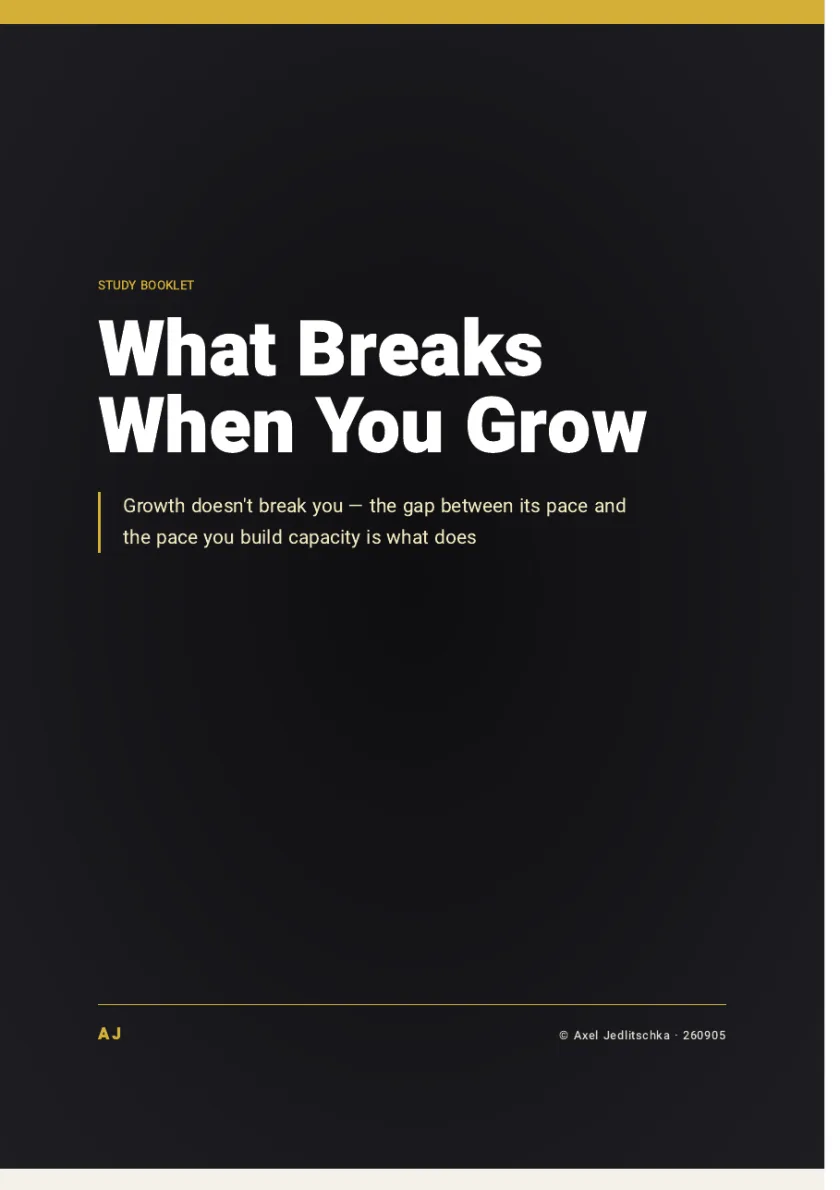
What Breaks When You Grow
- What the problem is
- Missing organisation: overexpansion is mostly underorganisation
- What you do
- Build what’s missing, at the pace of what comes in
- When you build
- In a fixed slot in the diary, for building only
If you also think “we grew too fast”, you’re not alone in that.
Where you are now
Could the problem be not the growth, but what didn’t grow with it? “So overexpansion is only underorganization in the main.” What looks like too much growth is almost always too little organisation.
And it costs you. You’re working longer hours than you did when there was less to do. “The number of man hours are measured in gallons of sweat”, and revenue doesn’t move.
And every hour you put into building capacity feels like an hour stolen from the work itself. The scramble for product is what wrecks the capacity to produce it.

Who’s talking to you: Axel Jedlitschka
It all started with an income and expenses table I wanted to build for myself. I built a few versions, moved to Google Sheets, and from there it kept developing, until those abilities really served me in my work.
Today I think about how to streamline my decisions, my time, my resources and my actions, to make my work easier. That is why I’m against “It’s faster to do it myself”: it’s right once, and wrong a hundred times.
Axel Jedlitschka
What to demand
Name what is happening, and understand why “we grew too fast” is almost never the right description.
Know the exact sequence of the collapse, and tell which stage you’re in.
Understand why enormous effort can produce zero, and exactly what’s missing when it does.
Spot the roles you’re filling without knowing it, in twenty minutes.
Spot overwhelm as a mechanical condition, not a feeling.
There is a way
“It’s continuous expansion of volume, continuous expansion of organization, continuous expansion of demand. Where one lags behind the others one gets trouble.” Volume is how much work comes in. Organisation is how much capacity you have to handle it. And demand is how many people want you.
“Now, the power of a motor… depends upon the base, it does not depend on the terminals, it depends on the base. It is the thing that holds the terminals apart and holds them in position.”
The way, in one booklet
What Breaks When You Grow · a booklet by Axel Jedlitschka
A name for the failure, a sequence that shows you where you stand in it, and one answer to the question of what comes first.
The comparison
Free
The offer
60 pages, 10 chapters, the exact sequence of the collapse, and five exercises
Price: FreeNo credit card, and no chapter is held back for payment
The booklet is free and you get it right away. You only get marketing messages if you tick the box, and you can unsubscribe at any time.
As soon as you leave your details, a thank-you page opens with a button to download the booklet.
By Axel Jedlitschka
What you get
There is no purchase and no payment here, so there is nothing to cancel. You can withdraw your consent to marketing messages at any time.
Questions?
You leave your details, and a thank-you page opens right away with a button to download the booklet as a PDF.
Yes. No credit card, and no chapter is held back for payment.
Set a fixed weekly slot in the diary purely for building, and protect it like a meeting with your biggest client. You can start there.
Your details are used to send you the booklet and to follow up on it. Marketing messages are sent only if you ticked the consent box, and you can unsubscribe at any time. You can also ask to see, correct or delete your details.
The booklet is complete, and no chapter in it is held back for payment. Every quote in it is anchored to a line in the source: 77 anchors, checked in the original Hebrew edition.
“It is as true for an org of four staff members as it is for one of two hundred.”
That is exactly why the slot is fixed in the diary, and for building only: a procedure, a tool, training, structure. Not “whenever there’s time”.
A question about the booklet: send a message on Instagram to @theonlyaxelj.
What now
You can keep up the scramble for product, or you can set a fixed weekly slot in the diary purely for building, and protect it like a meeting with your biggest client.
A 60-page PDF booklet: 10 chapters, the exact sequence of the collapse, and five exercises, free.
Price: FreeNo credit card
The booklet is free and you get it right away. You only get marketing messages if you tick the box, and you can unsubscribe at any time.
Free
Get the booklet