If you also say “It was a slow month” and don't know what to do next, you're not alone.

Where you are now

Could the problem be not the number, but what you do with it? You can shout at it, paste a piece of paper over it so you don't see it, or fake it. The source behind the booklet puts what all three have in common in one line: “an absence of skilled management.”

And it costs you, because the worst mistake is not getting the number wrong. It is getting the state wrong. An action meant for a lower state drops you into it.

As long as the number comes with no comparison and no state, every fall gets an explanation instead of an action, and finding excuses for a falling number does not raise it. It wasn't stable for me either, when I started out on my own.

Axel Jedlitschka

Who's talking to you: Axel Jedlitschka

When I started working for myself, it wasn't stable, because I was at the beginning of the road. Later, at a company that sold business consulting services, I built a system for analysing a business forecast, and it served the company's marketing and sales very well.

Today I think about how I can make my decisions, my time, the resources available to me and my actions more efficient. I am against excuses in place of a number, because finding excuses for a falling number does not raise it.

Axel Jedlitschka

What to demand

  • A number you can trust

    Tell a number that measures something from a number that only looks like a measurement.

  • Work on the thing, not the number

    Recognise three ways in which people work on the number instead of on the thing itself, and know which one is yours.

  • Read the line

    Turn the direction of the line on a graph into the name of a state. That is the whole of the diagnosis.

  • An action that fits the state

    Know the seven states, and understand why the wrong action is worse than doing nothing.

  • No excuses

    Recognise the excuse you tell yourself, and know what goes in its place.

There is a way

In the booklet, the weekly number is a “statistic”, a number compared with the earlier number of the same thing, and the state you are in is a “condition”. “STATISTICS ARE AN INDICATOR; THEY ARE NOT AN OBJECT.” Shouting at the number, ignoring it or explaining it does not change what it measures. The way is to look at the number, work out which condition you are in, and know exactly which action belongs to that condition. There are seven conditions, and each one has a formula of its own.

  1. Three numbers.Pick three numbers that measure a product, not effort.
  2. This week's line.Mark a dot, and use the table to find the state you are in. A level line is Emergency, not stability.
  3. The trend.Read the line six dots back, by eye, with no ruler.
  4. The formula.Run the formula for the state you diagnosed, and only that one. In Normal, that means don't touch anything.

Someone who stops looking at the number is like a driver who pastes a piece of paper over the speedometer and drives contentedly. Had he looked, he would have found three flat tires and an engine about to explode.

The way, in one booklet

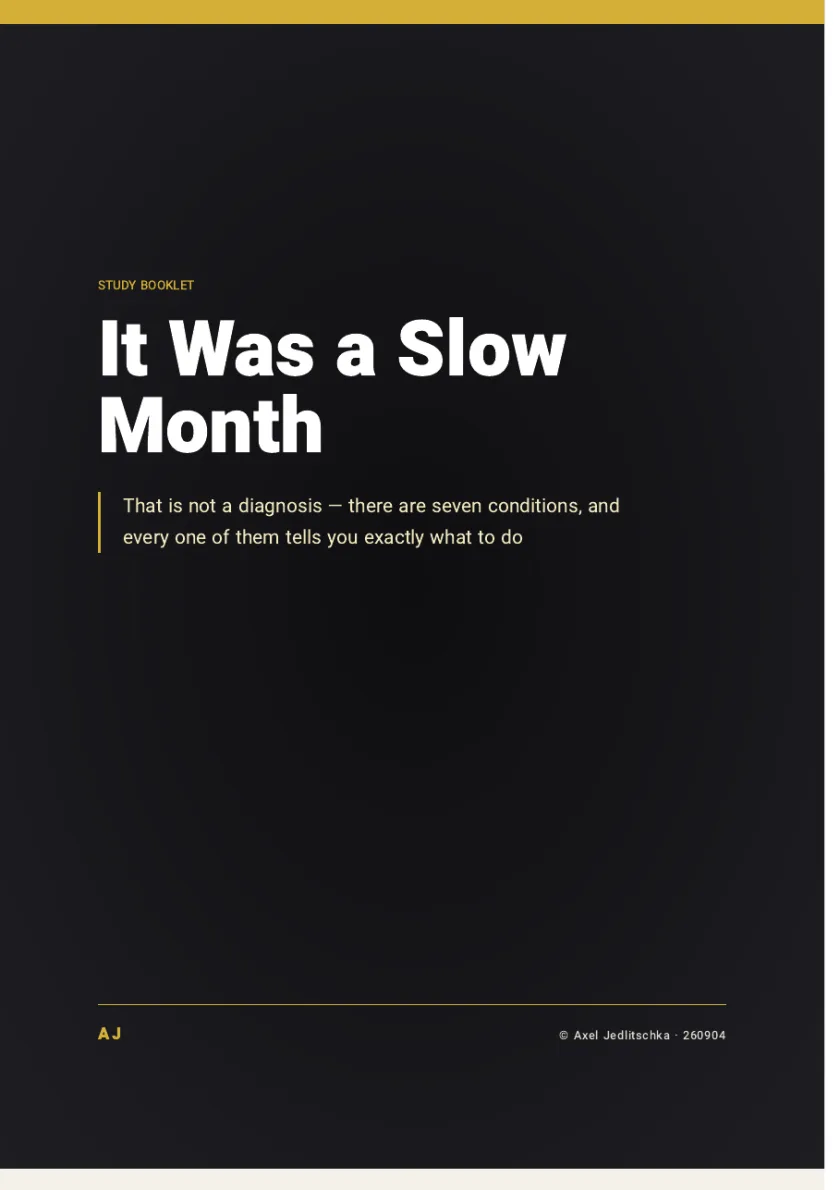
It Was a Slow Month · a booklet by Axel Jedlitschka

Three numbers, a table that turns a slant into a condition, and seven formulas.

  • Every quote in the booklet is anchored to a line in the source: 70 anchors, 0 failures, checked in the original Hebrew edition
  • The names of the conditions were confirmed against the Hebrew volumes of the source (original Hebrew edition)
  • Passages in the formulas that do not fit were taken out, and the steps that remain are clean throughout
  • 10 chapters, from a number you can trust to an explanation instead of a number
  • A table that turns the slant of a line into the name of a condition
  • Seven conditions, each with a formula
  • Five excuses, by name
  • A practice and application section with five exercises
  • A self-check at the end of every chapter
  • A glossary and a summary in ten lines
The cover of the booklet: It Was a Slow Month. That is not a diagnosis, there are seven conditions, and every one of them tells you exactly what to do

The comparison

Free

It Was a Slow Month

What you see
A number compared with the earlier one, and a trend read six dots back
What you do
The formula for the condition you diagnosed, and only that one
When the number falls
Prevention of the fall, and quick action to bring the number back up

A gut feeling

What you see
“It was a slow month”, with no how slow and no slow against what
What you do
Nothing, or panic
When the number falls
An explanation: “It will get better”, “Life is like that”

The offer

47 pages, 10 chapters, a table that turns a slant into a condition, and five exercises

Price: FreeNo credit card, and no chapter is held back for payment

The booklet is free and you get it right away. You only get marketing messages if you tick the box, and you can unsubscribe at any time.

As soon as you leave your details, a thank-you page opens with a button to download the booklet.

By Axel Jedlitschka

What you get

Promised

  • The full booklet, free, as soon as you leave your details.
  • No chapter is held back for payment.
  • Your details are not sold, and are not passed to anyone except the infrastructure providers that run the site.
  • A question about the booklet? Send a message on Instagram to @theonlyaxelj.

Not promised

  • A result. The booklet teaches you to diagnose and fix, and the result depends on how you apply it and on your business.
  • Personal advice. The booklet is general knowledge, not advice for your business.

There is no purchase and no payment here, so there is nothing to cancel. You can withdraw your consent to marketing messages at any time.

Questions?

How do I get the booklet?

You leave your details, and a thank-you page opens right away with a button to download the booklet as a PDF.

Is it really free?

Yes. No credit card, and no chapter is held back for payment.

I don't have time to read 47 pages.

If you take one thing away from the booklet, take the table in Chapter 3. It turns the slant of a line into the name of a condition, and that is the whole of the diagnosis. You can start there.

Will I get spam or phone calls?

Your details are used to send you the booklet and to follow up on it. Marketing messages are sent only if you ticked the consent box, and you can unsubscribe at any time. You can also ask to see, correct or delete your details.

A free booklet, so it must be an ad?

The booklet is complete, and no chapter in it is held back for payment. Every quote in it is anchored to a line in the source: 70 anchors, 0 failures, checked in the original Hebrew edition.

I'm not a numbers person.

You don't need spreadsheet formulas. “All you have to do is LOOK.” “It is done with the eye.” A dot and a line, ten minutes a week.

Where can I get help?

A question about the booklet: send a message on Instagram to @theonlyaxelj.

What now

You can say “It was a slow month” again, or you can fix a day and an hour, mark a dot, and read the line. Two minutes a week.

A 47-page PDF booklet: 10 chapters, a table that turns a slant into a condition, and five exercises, free.

Price: FreeNo credit card

The booklet is free and you get it right away. You only get marketing messages if you tick the box, and you can unsubscribe at any time.

The booklet is ready to download as soon as you leave your details

The booklet is free and you get it right away. You only get marketing messages if you tick the box, and you can unsubscribe at any time.

Your details are used to get back to you. What is collected, why, and who receives it: see the Privacy Policy (opens in a new tab).