

Free
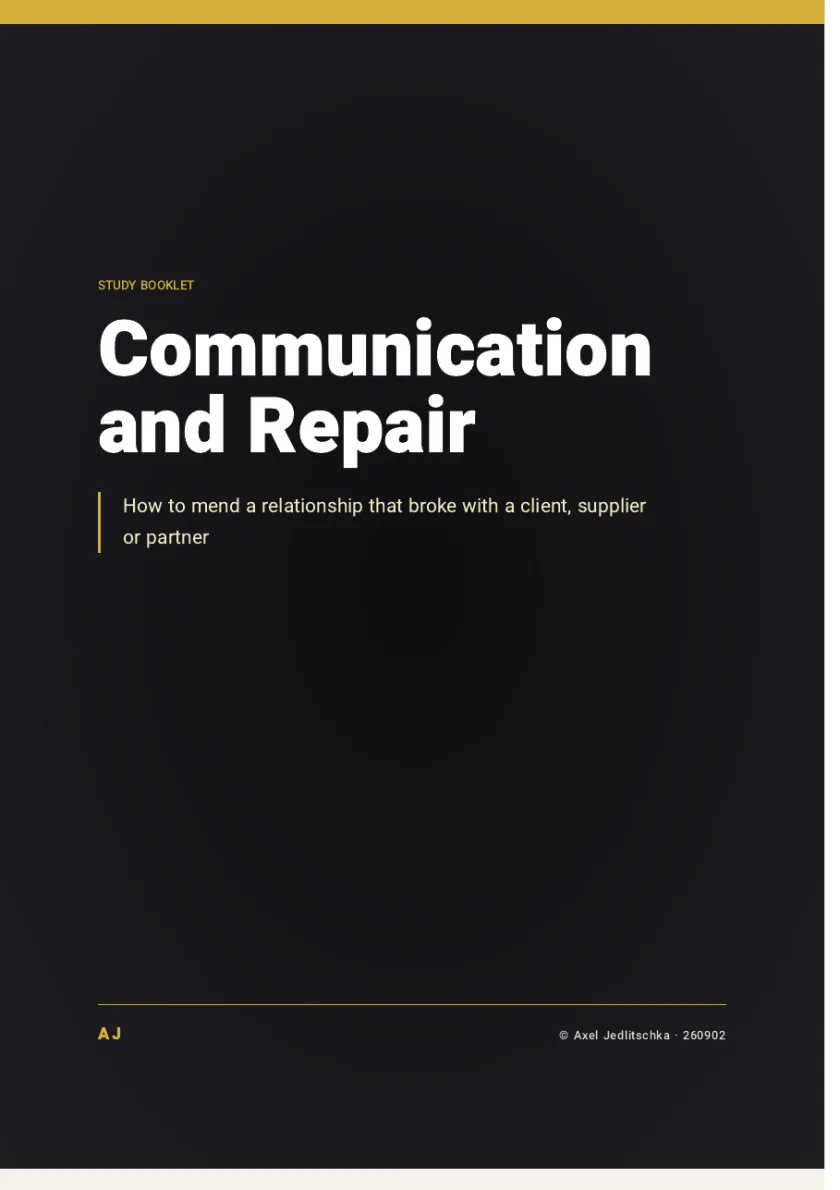
Communication and Repair
- What you diagnose
- Which of the three corners was cut
- What you do
- Raise it with the other two
- The conversation
- One question, a one-sentence apology, and resuming the conversation
If you also tell yourself “They do not understand”, and you don't know what exactly went wrong, you're not alone.
Where you are now
Could the explanation you give yourself be part of the problem? “They are busy, they are like that, it has passed.” It is comfortable, and it is almost always wrong, because it describes the person instead of describing what happened between the two of you.
And it costs you: “most of the conflicts we have landed in over a lifetime were caused by our failure to handle an upset with another person properly.” Not a deep disagreement: a small moment that went unhandled, and accumulated.
And as long as you do nothing, the break does not stay where it is. Every break that is not closed makes the next relationship dearer, not only the one that broke.

Who's talking to you: Axel Jedlitschka
On the phone I learned to sell, and to take a “no”. And when I decided to end the physical work, I decided to go and talk to the owner of the place, and tell her I would help her get through the holiday period, and that after that I was done.
That is why I am against silence: “the absence of communication is not a neutral state. It is an action, and it has a result.” When something breaks, nobody announces it. They simply stop.
Axel Jedlitschka
What to demand
Tell that a break has occurred, even when nobody has said a word about it.
Name the three things every relationship stands on.
Tell “they do not understand” apart from “we do not agree”, and handle each of them differently.
Recognise a break by its signs, and tell it apart from somebody who is simply overloaded.
Recognise the most common causes of a break with customers, and prevent most of them in advance.
There is a way
Every relationship stands on three things: affinity, meaning how much you like each other; reality, meaning what you agree on; and communication, meaning what actually passes between the two. The booklet calls each of them a corner. When something breaks, one corner was cut. And the moment you know which one, the repair is far shorter than it looks.
One corner that falls drags the other two down with it, like a spiral. And “fortunately the spiral works in both directions.” Raise one corner, and the other two come up with it.
The way, in one booklet
Communication and Repair · a booklet by Axel Jedlitschka
One tool that works on a client, a supplier, an employee and a partner.
The comparison
Free
The offer
50 pages, 10 chapters, a repair sequence of six steps, and four exercises
Price: FreeNo credit card, and no chapter is held back for payment
The booklet is free and you get it right away. You only get marketing messages if you tick the box, and you can unsubscribe at any time.
As soon as you leave your details, a thank-you page opens with a button to download the booklet.
By Axel Jedlitschka
What you get
There is no purchase and no payment here, so there is nothing to cancel. You can withdraw your consent to marketing messages at any time.
Questions?
You leave your details, and a thank-you page opens right away with a button to download the booklet as a PDF.
Yes. No credit card, and no chapter is held back for payment.
Pick one person whose relationship with you has gone cold, and run the six steps on them this week. Not the whole list. One.
Your details are used to send you the booklet and to follow up on it. Marketing messages are sent only if you ticked the consent box, and you can unsubscribe at any time. You can also ask to see, correct or delete your details.
The booklet is complete, and no chapter in it is held back for payment. Every quote in it is anchored to a line in the source: 65 quotes, 0 failures, checked in the original Hebrew edition.
That is exactly the moment. An open break does not stay where it is: every break that is not closed makes the next relationship dearer.
No. The booklet is general knowledge about communication, not legal advice. It does not promise that the relationship will be repaired, because the repair also depends on the other side.
A question about the booklet: send a message on Instagram to @theonlyaxelj.
What now
You can keep explaining to yourself that they are busy, or you can pick one person whose relationship with you has gone cold and run the six steps on them this week. One.
A 50-page PDF booklet: 10 chapters, a repair sequence of six steps and four exercises, free.
Price: FreeNo credit card
The booklet is free and you get it right away. You only get marketing messages if you tick the box, and you can unsubscribe at any time.
Free
Get the booklet