If you also hired somebody and it didn't work out, you're not alone in this.

Where you are now

Could the problem be not the person, but what they were given? An explanation out loud, once, on the first morning. Or “you'll pick it up as you go”. And “no initiative” is almost always a person who doesn't know what they're allowed to do.

And it costs you. “It's faster if I do it” is true today and wrong next month, because meanwhile nobody learns. “It costs money not to spend money pretraining for a post.”

And as long as what the role requires isn't written down anywhere, three months later you are recruiting again, and you find exactly the same thing.

Axel Jedlitschka

Who's talking to you: Axel Jedlitschka

I set up sales meetings by phone, ran sales meetings and service meetings, and started building systems and automations for business owners. That is how I learned to deal with business owners and to solve technology problems in business.

I took those jobs from a place of personal growth. In each one I asked myself “what can I learn in this job that will serve me in the future?” And that is why I am against “you'll pick it up as you go”: whoever learns that way learns a version of their own, and somebody has to correct it afterwards.

Axel Jedlitschka

What to demand

  • Where to look

    Know where to look when somebody is not performing, and why the list is far shorter than it appears.

  • Which document to write

    Know exactly which document you have to write for every role.

  • Confidence at work

    Understand why a one-page document changes how confident a person is at work.

  • Even the expert gets stuck

    Know why it is your most experienced employee who is most likely to get stuck, and why that is not their fault.

  • Not alone

    Know that “doing it all yourself” is a diagnosis with a named cause, and what that cause is.

There is a way

The list of guesses has no character, motivation, generation, market or luck on it. There are two reasons, both of them yours: you did not recruit, or you did not train the person for the role. The second is solved by one page that says what the role is. In the booklet that page is called a hat, because a hat means the duties of a post.

  1. Two reasons.For every case of “it didn't work out”, you ask one question: did I fail to recruit, or did I fail to train them for the role?
  2. The first page.One role, four things: the purpose of the role, what is actually done, what comes out, and how it is counted. One page, tonight.
  3. The decision boundary.One line: how far the employee decides alone, and above what they ask.
  4. Go through it together.“I wrote a procedure” and “the person is trained on it” are two different things, and only the second one counts.

Without a page like that, you have a mob, not a team: people who are each capable, with no division between them that anybody knows.

The way, in one booklet

The Person I Hired Isn't Working Out · a booklet by Axel Jedlitschka

A diagnosis that divides into two things only, and a one-page document that solves the second of them.

  • Every quote in the booklet is anchored to a line in the source: 62 anchors, no failures, checked in the original Hebrew edition
  • The booklet rests on the personnel series only, without the internal discipline mechanism of the source
  • The reasoning behind each statement was rewritten in business language
  • 10 chapters, from the two reasons to leaving a working team alone
  • The nine components of a role document, four of them to write tonight
  • Three statements about what a document like that does for a person
  • The four missing pieces when you do it all yourself
  • A practice and application section with five exercises
  • A self-check at the end of every chapter
  • A glossary and a summary in ten lines
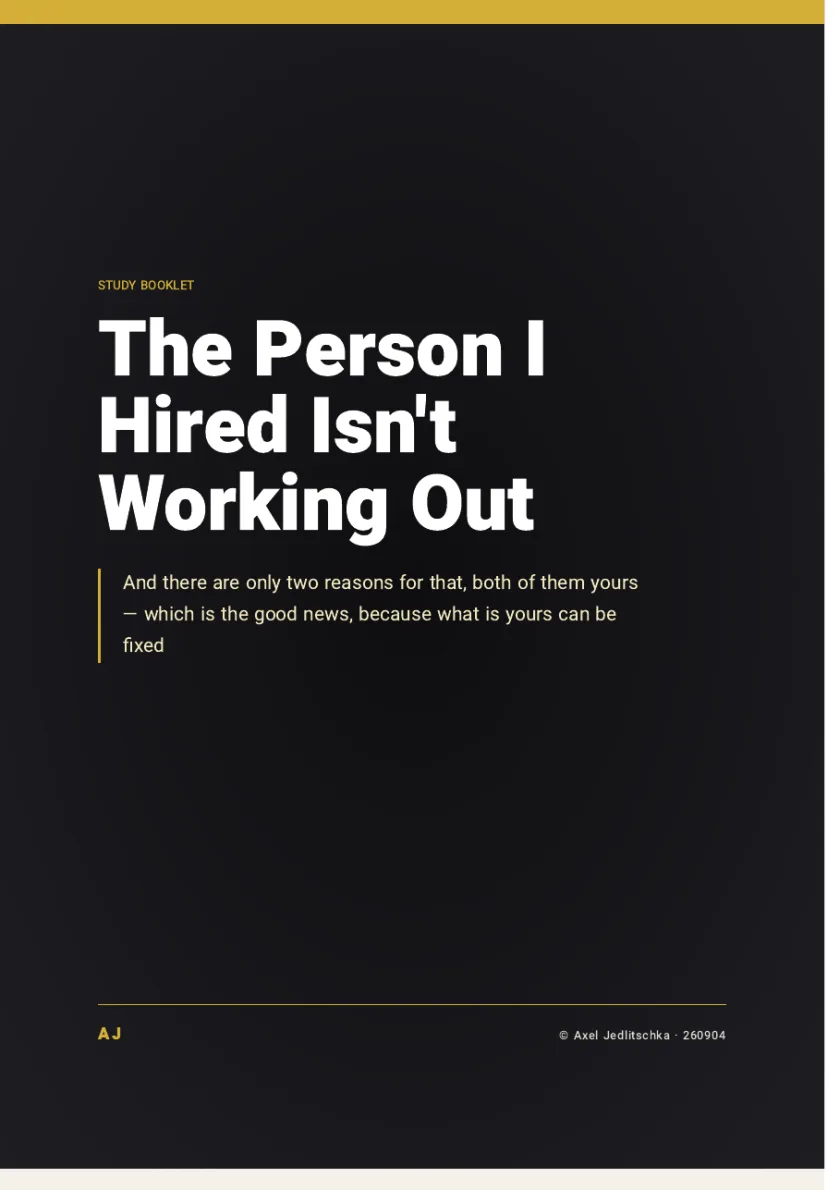
The cover of the booklet: The Person I Hired Isn't Working Out. And there are only two reasons for that, both of them yours, which is the good news, because what is yours can be fixed

The comparison

Free

The Person I Hired Isn't Working Out

How they know what to do
A written page: purpose, what is done, what comes out and how it is counted
When it isn't working out
One question: did I fail to recruit, or fail to train for the role?
Who does the work
The employee, following the page and with a clear decision boundary

Explaining out loud

How they know what to do
Once, on the first morning
When it isn't working out
A list of guesses: not experienced enough, no drive, never a fit
Who does the work
You, because “it's faster if I do it”

The offer

51 pages, 10 chapters, the nine components of a role document, and five exercises

Price: FreeNo credit card, and no chapter is held back for payment

The booklet is free and you get it right away. You only get marketing messages if you tick the box, and you can unsubscribe at any time.

As soon as you leave your details, a thank-you page opens with a button to download the booklet.

By Axel Jedlitschka

What you get

Promised

  • The full booklet, free, as soon as you leave your details.
  • No chapter is held back for payment.
  • Your details are not sold, and are not passed to anyone except the infrastructure providers that run the site.
  • A question about the booklet? Send a message on Instagram to @theonlyaxelj.

Not promised

  • A result. The booklet teaches you to diagnose and fix, and the result depends on how you apply it and on your business.
  • Legal advice. The booklet is general knowledge, not advice on employment law. It promises nothing about hiring, getting hired or letting people go.

There is no purchase and no payment here, so there is nothing to cancel. You can withdraw your consent to marketing messages at any time.

Questions?

How do I get the booklet?

You leave your details, and a thank-you page opens right away with a button to download the booklet as a PDF.

Is it really free?

Yes. No credit card, and no chapter is held back for payment.

I don't have time to read 51 pages.

If you take one thing away from the booklet, take Chapter 3. There are nine components in it, and you can write most of them tonight.

Will I get spam or phone calls?

Your details are used to send you the booklet and to follow up on it. Marketing messages are sent only if you ticked the consent box, and you can unsubscribe at any time. You can also ask to see, correct or delete your details.

A free booklet, so it must be an ad?

The booklet is complete, and no chapter in it is held back for payment. Every quote in it is anchored to a line in the source: 62 anchors, no failures, checked in the original Hebrew edition.

I have one employee, or none.

In a one-person business with one employee, the person responsible for training is you. And you can do it all yourself even when you are completely alone.

Is this advice on employment law?

No. “It will not teach you employment law and it will not hand you screening tests.” The booklet is general knowledge about managing people, and it makes no promise about hiring, getting hired or letting people go.

Where can I get help?

A question about the booklet: send a message on Instagram to @theonlyaxelj.

What now

You can recruit again and find the same thing, or you can pick one role and write four things tonight. One page.

A 51-page PDF booklet: 10 chapters, the nine components of a role document and five exercises, free.

Price: FreeNo credit card

The booklet is free and you get it right away. You only get marketing messages if you tick the box, and you can unsubscribe at any time.

The booklet is ready to download as soon as you leave your details

The booklet is free and you get it right away. You only get marketing messages if you tick the box, and you can unsubscribe at any time.

Your details are used to get back to you. What is collected, why, and who receives it: see the Privacy Policy (opens in a new tab).