

Free
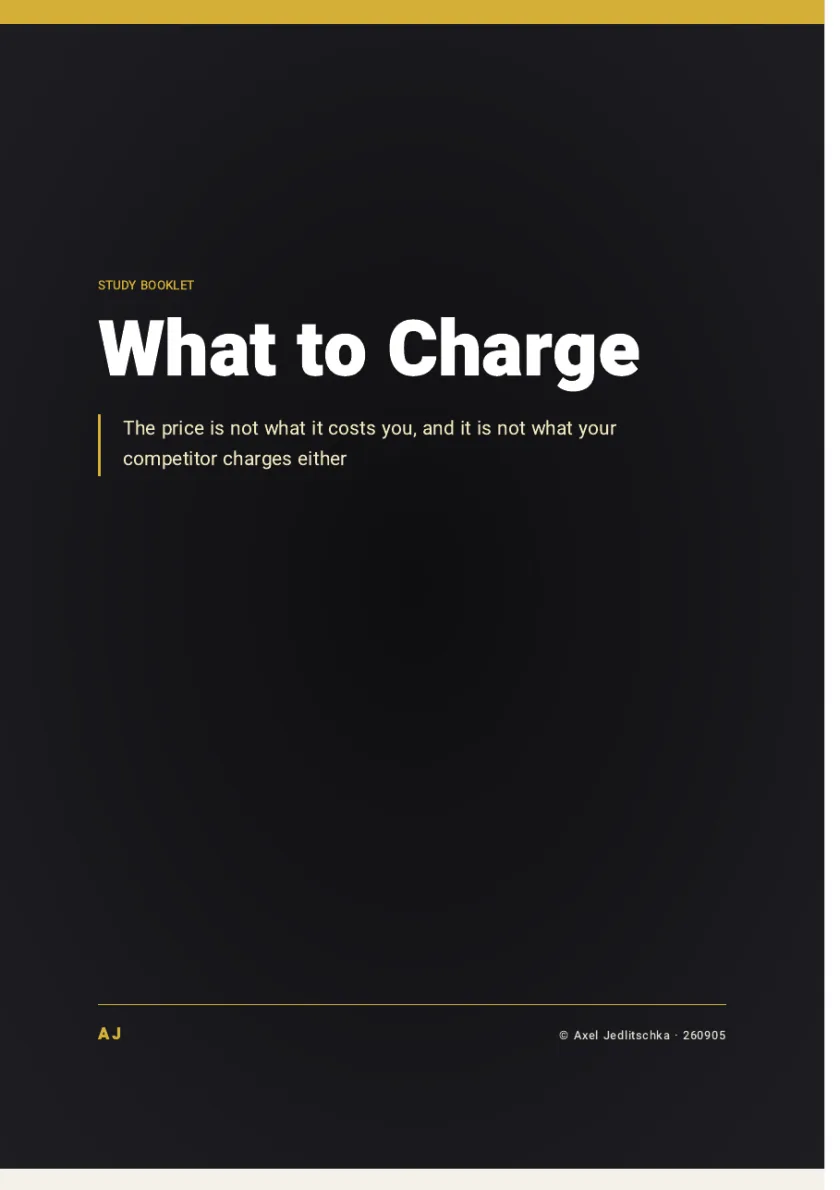
What to Charge
- Measured against
- The value in the eyes of the purchaser
- What the price covers
- Total expenses, room for losses and errors, and a reserve
- What says the price was right
- “They came back”
If you also say “I work so much and there's nothing left”, you're not alone.
Where you are now
Could it be that your price doesn't cover what it has to cover? Most self-employed people know what the materials cost and don't know what the labor cost. So they feel like they're making money, and at year's end they find out they weren't.
And it costs you. What you gave away for free was not free: it went into the price of something else, or it came out of your profit.
And waiving it disguises itself as generosity. But waiving isn't generosity when it's automatic. Generosity is a decision, and automatic waiving is a habit.

Who's talking to you: Axel Jedlitschka
I was told “work hard and it will be fine” and “everything will be okay.” I found out that none of it is accurate. My correction: work hard on yourself and it will be fine, and if you do something about it, everything will be okay.
I'm proud of my decision to take myself in hand, and to be the cause of my own future. So I'm against “I work so much and there's nothing left” as fate. A price is not something that happens to you. It is a decision.
Axel Jedlitschka
What to demand
Know what a price is measured against, and the two walls it has to sit between.
Know the one formula in the material, and what has to go into a price besides cost.
Calculate your own bottom wall, and recognize two opposite failures that look like a solution.
Know who pays for what you gave away for free, and the difference between a sample and an unpriced giveaway.
Know one sentence that names two opposite failures, and which one you're in.
There is a way
“Anything must be sold for a price comparable to its value in the eyes of the purchaser.” Not against the market, and not against the cost. Cost sets the floor only: below it you work and get ground down. Above the ceiling people stop buying, and it is set in the eyes of whoever pays. Your price sits between the two.
A shoe store sells shoes at no profit to push the number up, and makes no money. And from the other direction: “We try only to make money, we sell cheap shoes at high cost and our customers don't come back and we don't make money.”
The way, in one booklet
What to Charge · a booklet by Axel Jedlitschka
A method for pricing instead of copying, and one test that tells you whether the price was right: not on the day they paid, but on the day they came back.
The comparison
Free
The offer
54 pages, 10 chapters, the three components, and five exercises
Price: FreeNo credit card, and no chapter is held back for payment
The booklet is free and you get it right away. You only get marketing messages if you tick the box, and you can unsubscribe at any time.
As soon as you leave your details, a thank-you page opens with a button to download the booklet.
By Axel Jedlitschka
What you get
There is no purchase and no payment here, so there is nothing to cancel. You can withdraw your consent to marketing messages at any time.
Questions?
You leave your details, and a thank-you page opens right away with a button to download the booklet as a PDF.
Yes. No credit card, and no chapter is held back for payment.
Take one job you did this month, work out its real delivery cost, and compare it to the price. You can start there.
Your details are used to send you the booklet and to follow up on it. Marketing messages are sent only if you ticked the consent box, and you can unsubscribe at any time. You can also ask to see, correct or delete your details.
The booklet is complete, and no chapter in it is held back for payment. Every anchor in its ledger was checked against the body: 43 of 43 in use, checked in the original Hebrew edition.
There is a ceiling above which people stop buying. And there is a floor below which you work and get ground down. Your price sits between the two. And the test is not “They paid me”, but “They came back.”
No. The booklet is general knowledge, not advice for your business. It promises no amount, no return and no income.
A question about the booklet: send a message on Instagram to @theonlyaxelj.
What now
You can keep checking what everyone else charges, or you can take one job you did this month, work out its real delivery cost, and compare it to the price.
A 54-page PDF booklet: 10 chapters, the three components and five exercises, free.
Price: FreeNo credit card
The booklet is free and you get it right away. You only get marketing messages if you tick the box, and you can unsubscribe at any time.
Free
Get the booklet