

Free
Who Are You Actually Talking To
- What you change
- The recipient: you identify the audiences and survey each one
- What it rests on
- The words they said, not a polished version of them
- What it costs
- Free
If you've also concluded that “advertising doesn't work for me”, you're not alone. Almost every business owner thinks so at some point.
Where you are now
Could the problem be not the message, but who received it? Advertising never works on the wrong audience, so an ad aimed at the wrong people would have failed on any wording and any budget.
And it costs you twice. A message to the wrong audience costs a lot of money and gets no result, and then you also learn the wrong lesson from it, and stop trying.
As long as you don't know who you tried it on, “I tried it and it didn't work” tells you nothing, and “I have tried everything” turns out to be one thing, over and over, on the same audience. I used to sell on the phone too, and in the end I felt I was cheating people.

Who's talking to you: Axel Jedlitschka
From May to November 2021 I worked in telemarketing, selling internet provider services. There I learned to sell by phone and to take “no” for an answer, and in the end I felt burned out on the industry, and I didn't feel “ethical” toward the customers.
I left, and in my next job I booked sales meetings by phone, ran sales and service meetings, and started building systems and automations for business owners. I'm not against selling. I'm against promotion done without finding out who you are talking to, because without a survey “you are going in blind.”
Axel Jedlitschka
What to demand
See that the problem is not in the message, but in who received it.
Break your customers down into separate groups, and name each one.
Identify the people whose opinion settles things in your audience, and why they are not who you would think.
Turn a direct question into a question people actually answer.
Count answers properly, and find the answer that came back most often.
There is a way
Changing the wording, the picture or the budget doesn't change who reads the ad. And without asking them, you write a very accurate message to the person you are imagining. “When you mix it up, you fail.” And: “When you get it straight and survey it, you succeed.”
The words they said are the words you write, not a polished version of them. They open the door, and what goes through it is your message.
The way, in one booklet
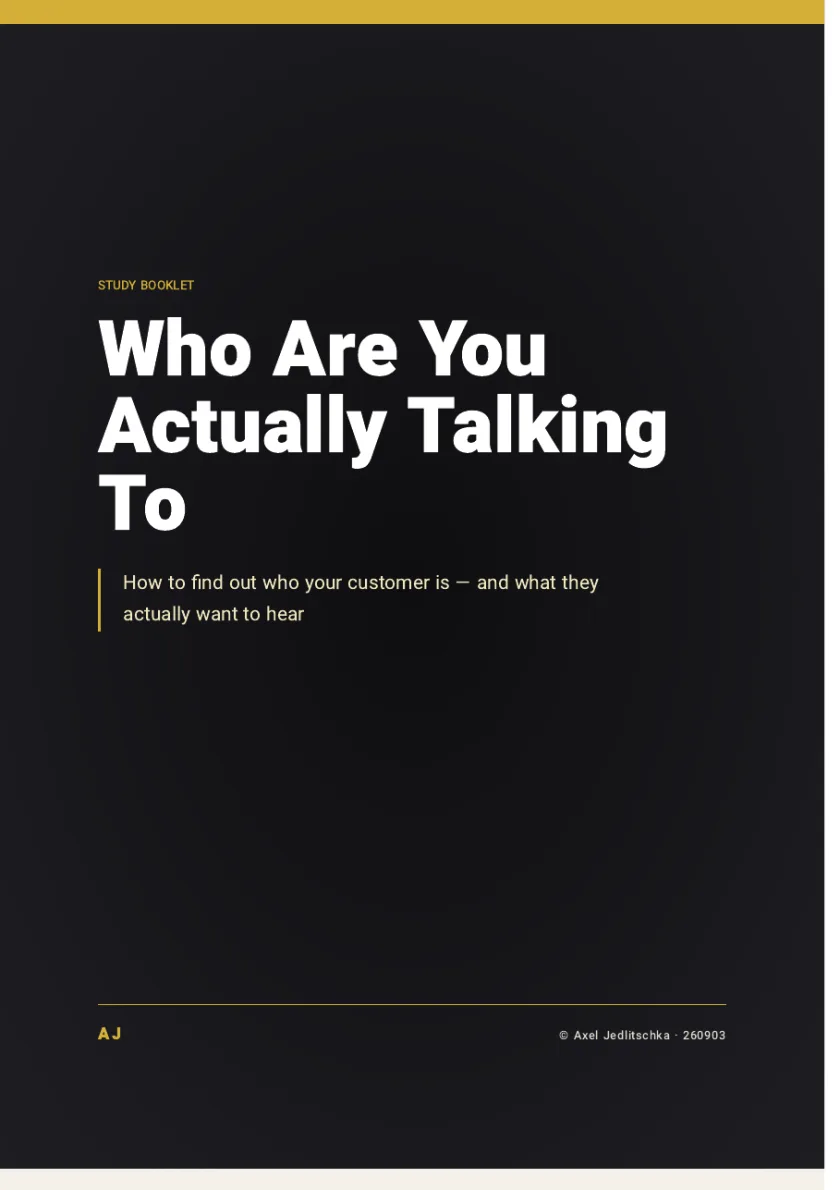
Who Are You Actually Talking To · a booklet by Axel Jedlitschka
Who your audiences are, and what each one wants to hear. That is enough to stop wasting a budget.
The comparison
Free
The offer
51 pages, 10 chapters, four questions that find the person your audience listens to, and five exercises
Price: FreeNo credit card, and no chapter is held back for payment
The booklet is free and you get it right away. You only get marketing messages if you tick the box, and you can unsubscribe at any time.
As soon as you leave your details, a thank-you page opens with a button to download the booklet.
By Axel Jedlitschka
What you get
There is no purchase and no payment here, so there is nothing to cancel. You can withdraw your consent to marketing messages at any time.
Questions?
You leave your details, and a thank-you page opens right away with a button to download the booklet as a PDF.
Yes. No credit card, and no chapter is held back for payment.
If you recognise yourself in the sentence “I tried advertising and it didn't work”, the first chapter is for you. You can start there.
Your details are used to send you the booklet and to follow up on it. Marketing messages are sent only if you ticked the consent box, and you can unsubscribe at any time. You can also ask to see, correct or delete your details.
The booklet is complete, and no chapter in it is held back for payment. Every quote in it was checked against the source: 59 quotes, no failures (original Hebrew edition).
You can guess, but until you actually find out, there is very little you can do about it. Two hours of finding out are far cheaper than a campaign fired in the wrong direction.
If you already knew it, and the situation still exists, it's probably a wrong Why.
What now
You can change the wording again, or you can pick your most profitable audience, ask ten people in it one question, and count.
A 51-page PDF booklet: 10 chapters, four questions that find the person your audience listens to, and five exercises, free.
Price: FreeNo credit card
The booklet is free and you get it right away. You only get marketing messages if you tick the box, and you can unsubscribe at any time.
Free
Get the booklet